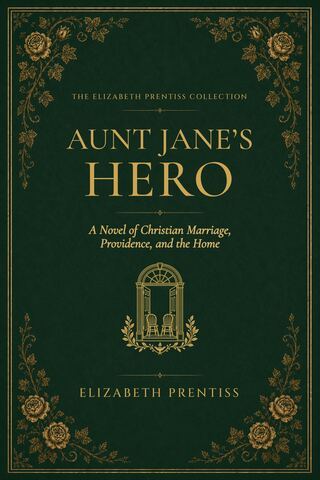

A wedding makes a satisfying ending for a romance. For Elizabeth Prentiss, it also makes a beginning. In Aunt Jane’s Hero, the important question is not simply whether two people will marry, but what kind of home they will make when admiration has to become patience, money must stretch, and illness interrupts their plans.
Readers who know Prentiss through Stepping Heavenward will recognize her interest in growth through ordinary life. This 1871 novel gives that interest a different shape: a young man’s ambition, the lasting consequences of war, and the daily work of marriage.
Aunt Jane’s Hero Is Not Yet a Hero
Horace Wheeler begins with good looks, confidence, and an enviable opinion of himself. Aunt Jane has known him long enough to see beneath the surface. Their conversations bring affection and correction together, and Prentiss’s humor keeps the opening from becoming a solemn lecture on character.
The title invites us to watch a reputation being tested. Horace’s future cannot be built on charm alone. The story asks what remains when a man’s imagined life meets circumstances he cannot control.
The War Comes Home
The Civil War is not a remote backdrop. Horace enlists, is wounded, and loses a leg. His use of an artificial limb, restrictions on movement, and need for suitable work continue to matter after courtship. The injury does not disappear when the love story reaches its wedding.
Nor does Maggie’s love function as a cure. Their circumstances can improve, and practical help can ease the burden, without undoing the loss. That distinction gives the household story weight: affection must take account of actual bodies, expenses, and limits.
“The Prose That Follows the Poem”
Prentiss calls attention to “the prose that follows the poem.” Romantic feeling is real, but it is not the whole of married life. Work, food, money, hospitality, illness, and service to neighbors are not distractions from the marriage plot. They are where the marriage becomes visible.
This is domestic fiction rather than a marriage manual. Its questions arrive through choices, conversations, mistakes, and consequences. The reader sees ideals tested in a room or a budget rather than merely stated as rules.
Faith in the Ordinary Duties
The Christian home Prentiss imagines is not a household protected from trouble. Faith changes how its inhabitants meet trouble and how they use what they have. Prayer, contentment, and neighbor love belong alongside the practical details of earning and spending.
Her interest in prosperity is equally searching. Comfort does not by itself form character, any more than hardship guarantees wisdom. The novel keeps asking what people love, what they expect from one another, and whether their habits serve the home they profess to value.
A Wider Elizabeth Prentiss
Aunt Jane’s Hero appeared in New York in 1871 from A. D. F. Randolph and Company. The bibliography in the 1882 Life and Letters of Elizabeth Prentiss records its early republication in England and appearance in French. A surviving 1873 Routledge edition provides a British resetting of the story.
That history is a reminder that Prentiss’s literary life extends beyond her best-known novel. She wrote for adults and children, as well as producing devotional prose, poetry, hymns, and translation. Recovering this book is a way to read more of that range, not merely to add a footnote to Stepping Heavenward.
For the life behind the writing, visit our Elizabeth Prentiss biography or explore The Life and Letters of Elizabeth Prentiss.
Sources and Further Reading
- Elizabeth Prentiss, Aunt Jane’s Hero, 1871 Randolph first American edition: Boston Public Library copy.
- George L. Prentiss, The Life and Letters of Elizabeth Prentiss (1882), its account of her writing and appended bibliography.
- Aunt Jane’s Hero, 1873 George Routledge and Sons edition: British resetting.
Read Aunt Jane’s Hero
Newly typeset from the 1871 first American setting, with the devotional opening, all twenty narrative chapters, and an original historical and literary introduction. The original publisher’s advertisements are not included.